

Old safe disposal is usually the last thing on the list when you move, renovate or close an office, yet it is often the hardest item to get out of the building.
An old safe is easy to ignore and hard to get rid of. It sits in a cupboard, garage or back office for years, until a move, renovation or business closure forces a decision. Then the problems show up together: the weight, the stairs, and the question of where a steel box that size actually goes.
Domestic and commercial units range from small document boxes up to 1.5 tonnes. A trolley and two helpers put floors, doorways and backs at risk, and a slipped load can injure the people carrying it. Disposal is the second half of the job, and most owners plan it last.
This guide covers when to remove a safe, what the safe removal service involves and how to choose a company you can trust.
On this page
Why Safe Removal Requires Professional Help
A safe’s size tells you little about its weight. Concrete-lined fire safes and thick-walled security units often weigh far more than they look, and the weight is rarely printed on the outside. The rating plate is usually inside the door. Guessing wrong is how people end up with a 400 kilogram load on a two-person plan.
Weight is also badly placed. Most of the mass sits in the walls and door, so the unit tips easily and drops fast once it starts to go. On stairs, that means the person below has almost no time to react.
Then there is what the safe is attached to. Many are bolted to a concrete slab or wall, and some are set into the structure. Removing one means finding and freeing the anchors without damaging the unit or the building.
Where DIY attempts usually fail
- Underestimating weight, so the equipment is wrong from the start
- Point loading, where a heavy safe on trolley wheels can crack tiles or mark timber floors
- Ignoring contents, since a full document safe can be much heavier than an empty one
- Skipping the route check, then finding a doorway or turn is too tight
Empty the safe first. Confirm the weight from the plate. Measure every doorway and turn. If the route involves stairs or the unit is bolted down, hire a crew.
When Should You Remove or Dispose of an Old Safe?
Remove an old safe when it stops protecting anything or when it gets in the way of something else. Waiting rarely helps. A dead safe still takes up space, and the job gets harder if the unit is bolted down or the access changes.
Signs the safe has stopped doing its job
A lost combination, a jammed lock or a damaged door leaves you with a heavy steel box and no security. The same applies when the safe is too small for what you now store. Fire protection is another trigger. If the unit is decades old, ask a locksmith or the manufacturer whether it still meets your needs.
Situations that force the decision
- Renovations that need the wall, floor or cupboard space
- Office closures, downsizing or a move to new premises
- Property sales, where a bolted-in safe affects the handover
- Deceased estates, where contents need sorting before the unit leaves
Should you move it or dispose of it?
The answer depends on whether the safe still does its job.
Move it if:
- The lock works and the door closes fully.
- It holds everything you need to store.
- It can reach its new spot. Measure the doorways, corridors and stair turns on the route before you book. A safe that cannot fit through the space is a wasted move, however good its condition.
Dispose of it if:
- The lock is jammed or the door is damaged. The safe no longer protects your valuables, and moving it only carries the problem to a new address.
- It is too small for what you store.
- It cannot reach its new spot.
Ultimately, check the price. Relocating a heavy unit can approach the price of a comparable replacement, particularly when stairs or tight access are involved. Get quotes for both options, then choose based on what you will actually use.
What Does Safe Removal Service Involve?
A safe removal service follows a set order, from the first enquiry to the final carry-out. Knowing the steps helps you prepare and spot a crew that skips them.
1. Quote and assessment
The crew needs four details: the type of safe, its estimated size and weight, the pickup and drop-off locations, and the access conditions. Photos of the safe and the route help. A rating plate, usually inside the door, gives the exact weight.
2. Route check
Before lifting, the crew measures the doorways, corridors and stair turns between the safe and the vehicle. They also check for steps, tight corners and floor surfaces that need protection.
3. Preparation
The owner empties the safe and removes all contents. A full document safe can weigh far more than an empty one. If the unit is bolted to a floor or wall, the crew frees the fixings without damaging the safe or the structure.
4. Protection and lifting
Floors and access points get covered. The crew then moves the unit with equipment matched to its weight, such as trolleys and straps for standard loads and heavier gear for larger ones. Stairs need extra hands and a slower pace.
5. Loading and transport
The safe is secured in the vehicle so it cannot shift on the road. The crew then drives it to the new address or to the disposal site.
6. Placement or disposal
For a relocation, the crew positions the safe in its new spot. For disposal, the unit goes to a facility that accepts heavy steel, and no further handling falls to you.
How Does Old Safe Disposal Work?
Once a safe leaves your property, it follows one of two routes: recycling or reuse.
Recycling (the usual route)
Most safes are built from steel, which metal recyclers accept. The unit goes to a recycling facility, where it is stripped down and the metal is melted for reuse. Models with concrete or fire-resistant lining are harder to process. The lining has to be separated from the steel, so not every site takes them.
Reuse
A newer safe in good working order can be resold or passed on, which avoids scrapping it. This suits modern units with intact locks and doors. It rarely suits older or damaged ones.
How to Choose a Safe Removal/Disposal Service in Sydney
The company you pick decides how the job goes. A safe is one of the few household items where a poor choice can injure a person, damage a building and leave the disposal unresolved. Four factors separate a reliable safe disposal company from a general junk collector.
Insurance
A safe weighs enough to crack tiles, gouge floorboards and break stair rails in seconds. Without proper cover, the cost of that damage falls on the property owner. Insurance makes the company accountable for its own work.
Experience with heavy safes
Safes concentrate their weight in the walls and door, and many are bolted to the floor or wall. Safe disposal specialists handle these conditions regularly, so they plan the lift, the route and the fixings before the work starts. A general collector meets them for the first time on the day, and that is when injuries and damage occur.
Complete service from lift to drop-off
A safe that is removed but not disposed of leaves the owner with the same problem in a different place. A company that manages the carry-out, the transport and the drop-off keeps the responsibility in one place. Split arrangements add extra bookings and extra handling, and each handoff is another chance for damage.
Local knowledge
Sydney properties vary from narrow terrace staircases to strata buildings with lift and parking rules. A company that works in the area regularly knows these limits and allows for them in the quote and the schedule. That keeps the price close to the final cost and the job on time.
Old Safe Disposal Checklist for Sydney Homes and Offices
A little preparation makes old safe disposal quicker and avoids surprises on the day. Work through these steps before the removalists arrive.
1. Empty it and check every compartment
Remove documents, cash boxes, jewellery and anything in hidden drawers or shelves. Once a safe leaves for recycling, whatever is inside goes with it. If the safe held business records, shred or securely store the paperwork before the move.

2. Find the key or combination
A safe that can’t be opened can still be removed, but you lose the chance to check it is empty. If the code is lost, a locksmith or safe technician can open it first; we move and dispose of safes, but we don’t open or repair them.
3. Check whether it is bolted down
Many safes are anchored to the floor or a wall. Let us know when you request a quote, so the removal and disposal can be planned with the right tools and time.

4. Photograph the safe and the way out
Photos of the safe, its label or approximate size, and the route to the street (steps, stairs, tight turns, driveway slope) let us quote accurately. They also show which equipment the crew will bring.
5. Ask what happens to it afterwards
Most old safes are steel and can be recycled rather than sent to landfill. If you would like to understand the options in your area, Recycling Near You lists scrap-metal recyclers across NSW. When we handle old safe disposal for you, the safe is taken away for responsible disposal so you don’t have to arrange transport to a yard yourself.
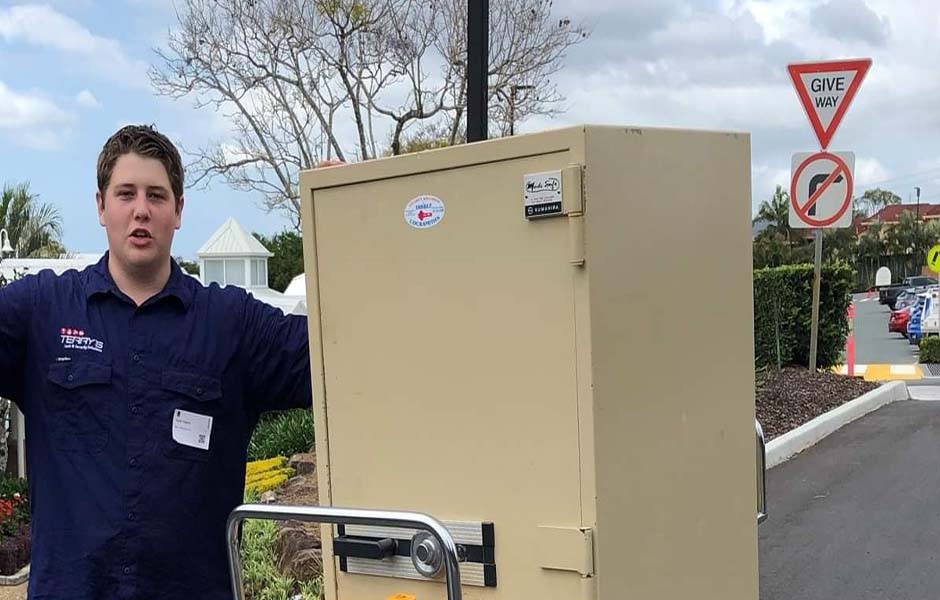
For the full service, see our safe removal and disposal page, or for very large units our heavy safe removals service. When you’re ready, send the details and photos through the free quote form or call 0415 268 521.
Why Choose Sydney Safe Removals?
Sydney Safe Removals has moved heavy safes and cabinets for over 20 years. Our crew handles stairs, tight hallways and bolted units as routine work.
What you get
- Full insurance. Cover applies from collection to delivery.
- Heavy safe capability. We move home, office, gun, fireproof and bank safes up to 1.5 tonnes and 1.5 metres tall.
- Removal and disposal in one job. One crew carries out, transports and delivers the safe to the disposal site.
- Wide coverage. Based in Sydney, we also take jobs in the Blue Mountains, Central Coast, Wollongong and Southern Highlands.
Get a quote
Send the safe type, estimated size and weight, pickup and drop-off locations, and access conditions. Photos help.
Call 1300 24 26 70 or 0415 268 521, or email enquiry@sydney-safe-removals.com.au.
Frequently Asked Questions (FAQs)
1. How much do safe removal services cost in Sydney?
The price depends on the safe’s weight and size, the stairs or tight access, and the distance. Send us these details and we will quote the exact cost.
2. Can you remove a safe that is locked or has a lost combination?
Yes, a locked safe can still be moved, but tell us before the booking so we can plan. If it needs opening first, a locksmith can usually do that.
3. Do you remove safes that are bolted to the floor or wall?
Yes. Tell us how the safe is fixed, and send a photo if you can, so we bring the right tools for the job.
4. Can you move a safe from an upper floor or a unit with no lift?
Yes, we move safes up and down steps and through tight hallways. Send us the access details so we can plan the crew and equipment.
5. How long does a safe removal usually take?
It depends on the safe’s weight, the access route and the distance to the drop-off. We confirm the timing when we quote.